New Hampshire Paycheck Calculator
See what a New Hampshire salary actually pays after federal income tax, Social Security, Medicare. Updated for the 2026 tax year.
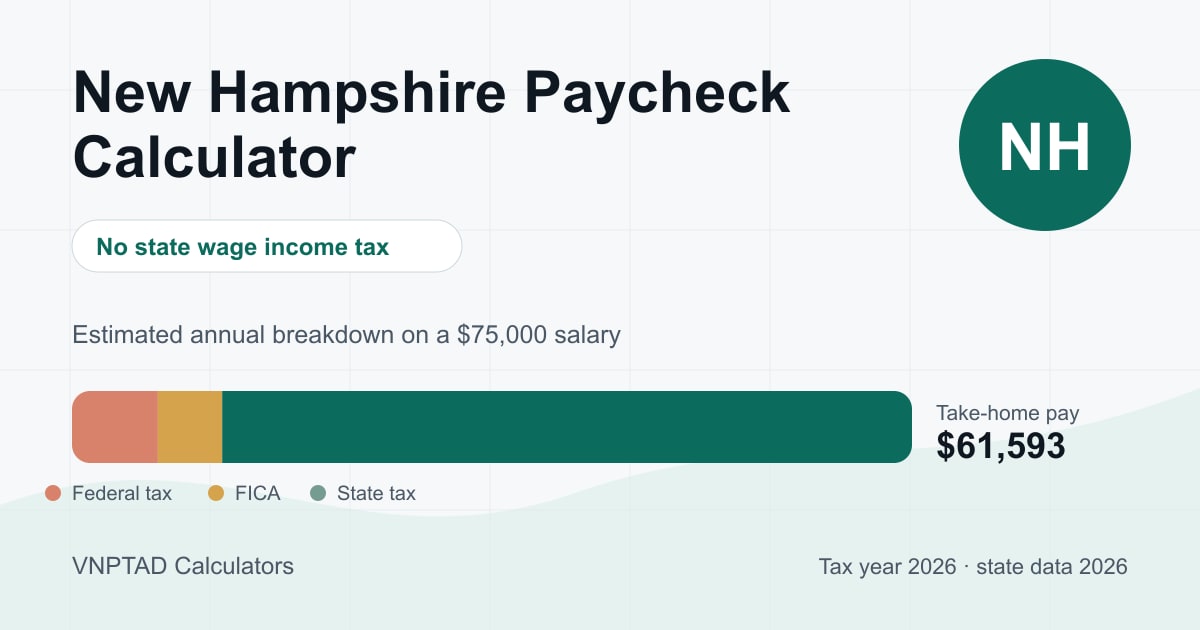
Take-home pay per bi-weekly paycheck
$2,368.94
Annual take-home
$61,592.50
Effective tax rate 17.88%
State rates for New Hampshire have not been verified against the state revenue department for the current tax year. Treat the state line as an estimate.
| Item | Per paycheck | Per year |
|---|---|---|
| Gross pay | $2,884.62 | $75,000.00 |
| Federal income tax | -$295.00 | -$7,670.00 |
| Social Security | -$178.85 | -$4,650.00 |
| Medicare | -$41.83 | -$1,087.50 |
| Take-home pay | $2,368.94 | $61,592.50 |
State tax figures sourced from the New Hampshire revenue department for tax year 2026. Federal figures from the IRS for tax year 2026.
Taxes on a New Hampshire paycheck
New Hampshire does not tax earned wages. Its tax on interest and dividends has been phased out, and it never applied to salary.
Take-home pay at common New Hampshire salaries
Single filer, paid every two weeks, standard deduction, no retirement or benefit deductions. Your own figure will differ once those are included — use the calculator above for that.
| Gross salary | Per paycheck | Annual take-home | Effective rate |
|---|---|---|---|
| $50,000 | $1,629.04 | $42,355.00 | 15.3% |
| $75,000 | $2,368.94 | $61,592.50 | 17.9% |
| $100,000 | $3,045.38 | $79,180.00 | 20.8% |
| $150,000 | $4,376.58 | $113,791.00 | 24.1% |
What "no income tax" does and does not mean
New Hampshire not taxing wages is a genuine advantage on payday, and it is the reason the same salary stretches further here than in a state with a 5% to 10% rate. It is worth being precise about the limits of that advantage.
- Federal tax is unchanged. Federal income tax and FICA are the same in all fifty states. They are also the larger share of most people's withholding.
- The money is collected somewhere. States without an income tax lean harder on property tax, sales tax, or resource revenue. Whether you come out ahead depends on what you own and what you spend.
- Residency is about where you live, not where the company is. Working remotely for a New Hampshire employer while living elsewhere generally means you owe tax in the state you live in.
Checking this against your pay stub
Take your most recent stub and compare it row by row against the table in the calculator. Federal, Social Security and Medicare should line up closely. If the total is off, the difference usually sits in one of these:
- A W-4 with dependents claimed, extra withholding, or a second job entered in Step 2
- Pre-tax benefit deductions you have not entered above
- A local city or county income tax, which this calculator does not model
- Year-to-date effects, such as Social Security stopping once you pass the wage base
Compare take-home pay with other states
State withholding is only one part of the comparison, but using the same salary and filing status makes the paycheck difference easy to see.
Frequently asked questions
Does New Hampshire have a state income tax?
New Hampshire does not tax earned wages. Its tax on interest and dividends has been phased out, and it never applied to salary.
How much is taken out of a paycheck in New Hampshire?
On a $75,000 salary paid every two weeks, a single filer in New Hampshire takes home about $2,368.94 per paycheck, or $61,592.50 for the year. That is an effective tax rate of 17.9% once federal income tax, Social Security and Medicare are counted.
What is withheld from my paycheck if New Hampshire has no income tax?
Federal income tax, Social Security at 6.2% up to $184,500, and Medicare at 1.45% with no cap. Your employer may also deduct health premiums and retirement contributions, but no state income tax is withheld.
Is it cheaper to work in New Hampshire than in a high-tax state?
On the paycheck itself, yes — no state income tax means more take-home pay from the same salary. Whether you come out ahead overall is a different question. States without an income tax typically collect more through property and sales taxes, and housing costs vary far more than tax rates do.
Related calculators
- Sales Tax Calculator Add sales tax to a price, or work backwards from a tax-included total to find the price before tax.
- Self-Employment Tax Calculator See your Social Security and Medicare tax on freelance or business income, including the deduction most people miss.
- Bonus Tax Calculator See what a bonus is taxed under the flat 22% method versus what you likely actually owe.