Credit Card Payoff Calculator
Credit card minimums shrink as the balance falls, which is why paying only the minimum can stretch a balance out for decades. Compare that against a fixed payment you choose yourself.
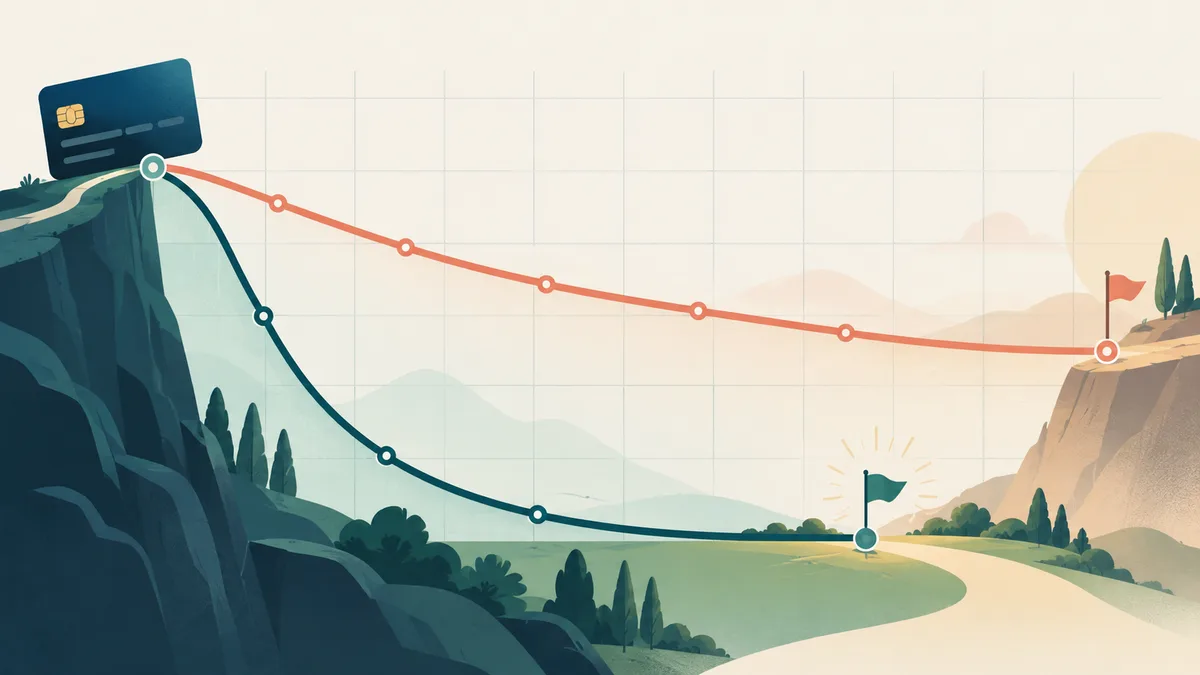
Minimum payments only
50+ years
Total interest: $34,783.50
Fixed payment
2 years 10 months
Total interest: $1,749.88
Show month-by-month schedule
| Month | Payment | Interest | Principal | Balance |
|---|
Why the minimum payment is a trap
A credit card's minimum payment is not a fixed number. Issuers set it as a percentage of whatever you currently owe, commonly 1% to 3%, with a dollar floor such as $25 so the payment never gets trivially small. That structure makes the minimum fall every single month, because the balance it is calculated from is falling too.
Take a $5,000 balance at 22% APR with a 2% minimum and a $25 floor. The first month's minimum is $100, and interest alone that month is roughly $92, so barely $8 goes toward the actual debt. As the balance edges down, next month's minimum is a little smaller too, and it is still mostly covering interest. On these exact numbers the balance can still be over $1,800 fifty years later, having paid more than $34,000 in interest along the way, because the required payment keeps shrinking in step with a balance that shrinks only slightly faster than interest adds to it. Fix the payment instead, at $200 a month regardless of what the minimum says, and the same $5,000 clears in under three years for around $1,750 in total interest. The balance is identical; only the payment size stayed constant instead of shrinking.
The disclosure your statement is required to show
This is not a niche calculation. The CARD Act of 2009 requires every US credit card statement to display, in a standard box, how long minimum-only payments would take to clear the current balance and the total interest that would cost, alongside the payment amount that would clear it in 36 months for comparison. If you have never noticed that box, it is worth reading on your next statement before you assume the minimum is a reasonable way to carry a balance.
How your payment gets allocated across balances
Many cards carry more than one balance at once — a promotional rate on a balance transfer, a standard rate on new purchases, and sometimes a cash advance rate higher still. Federal rules require that the required minimum can be applied however the issuer chooses, but any amount you pay above the minimum must be applied to the balance carrying the highest interest rate first. In practice that means an extra payment on a card with a mix of rates is doing exactly what you would want it to do automatically, without you having to specify anything.
Balance transfers: what the fee actually costs
A balance transfer moves debt to a new card, usually at a promotional rate as low as 0% for a set period, in exchange for a one-time transfer fee, typically 3% to 5% of the amount moved. The comparison is straightforward: the fee is a known, fixed cost paid once, against interest you would otherwise pay every month at your current rate. On a $5,000 balance at 22% APR, one year of interest alone exceeds $1,000; a 4% transfer fee on the same amount is $200. The offer is worth taking if, and only if, you can realistically clear the transferred balance before the promotional period ends — a low rate that reverts to a high standard rate on a balance you have not yet paid down defeats the purpose.
Paying off several cards at once
With balances on more than one card, the choice is between paying the highest rate first (avalanche) or the smallest balance first (snowball). Our loan payoff calculator walks through that trade-off in detail; the short version is that avalanche costs the least overall and snowball tends to get finished, and either beats a plan that never gets followed.
What this calculator does not include
- New purchases added to the card while you are paying it down
- Late fees, which are separate from interest and can be $30 or more per occurrence
- A penalty APR, which some issuers apply after a missed or late payment and which can run well above your standard rate
- Annual fees or other card charges
- A variable APR that moves with the prime rate rather than staying fixed for the life of the balance
Frequently asked questions
Why does my minimum payment keep getting smaller as I pay the card down?
Most issuers set the minimum as a percentage of your current balance, commonly 1% to 3%, with a dollar floor such as $25. As you pay the balance down, that percentage shrinks with it, so the required minimum falls month after month. A falling payment sounds like progress, but it also means less and less of each payment is going to principal, which is exactly why minimum-only repayment can take decades.
Why does my statement say it will take so long to pay off the minimum?
US federal law, the CARD Act of 2009, requires every credit card statement to show how long you would take to pay off the current balance making only minimum payments, and how much total interest that would cost. Issuers also have to show the payment needed to clear the balance in 36 months for comparison. That box is not a marketing estimate; it is a required, individually calculated disclosure based on your actual balance and rate.
If I carry balances at different interest rates, where does my payment go?
The CARD Act also governs this. The required minimum payment can be applied however the issuer allocates it, but any amount you pay above the minimum must, by law, be applied to the balance with the highest interest rate first, then the next highest, and so on. This matters most after a balance transfer, when a card can be carrying a low promotional rate on the transferred amount and a much higher standard rate on new purchases.
Is transferring the balance to a 0% card worth the transfer fee?
Usually yes, if you can pay off the transferred balance before the promotional period ends. A typical transfer fee is 3% to 5% of the amount moved, charged once, up front. Compare that one-time cost against the interest you would otherwise pay over the promotional window at your current rate. On a $5,000 balance at 22% APR, a single year of interest alone is over $1,000, which a 3% to 5% fee of $150 to $250 comfortably beats, provided the debt is actually cleared before the promotional rate expires and reverts to a standard rate.
Should I pay off my highest-rate card first or my smallest balance first?
These are the two standard strategies for tackling several cards at once: highest rate first (avalanche), which minimises total interest, and smallest balance first (snowball), which closes accounts sooner and tends to be easier to stick with. Our loan payoff calculator covers the trade-off between the two in more detail; the short version is that avalanche saves more money and snowball saves more motivation, and the gap between them shrinks as the rates get closer together.
Related calculators
- Mortgage Calculator Full PITI payment — principal, interest, taxes, insurance and PMI — including when PMI drops off.
- Loan Payoff Calculator Find out how much interest an extra monthly payment saves, and how many years it cuts.
- Paycheck Calculator See your exact take-home pay after federal tax, FICA and state withholding.