Loan Payoff Calculator
Enter your loan and see the full amortisation — then add an extra monthly payment and watch the interest and the payoff date drop.
Monthly payment
$489.15
Total interest
$3,483.78
Paid off in
4 years 1 month
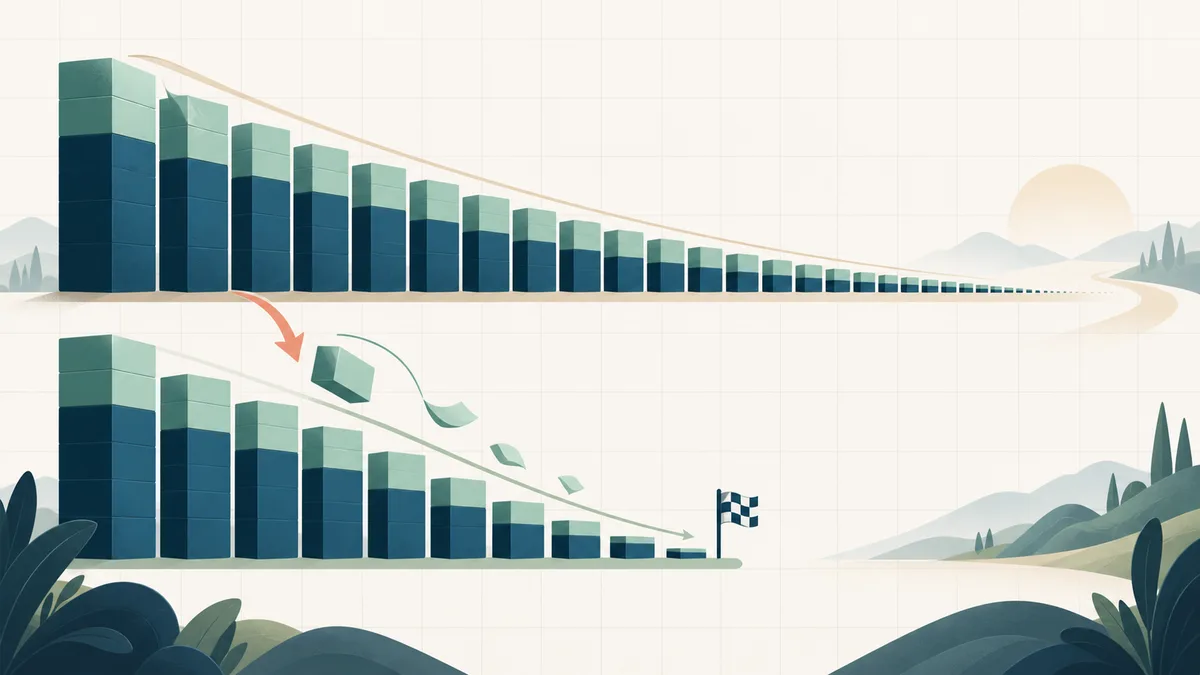
Paying an extra amount each month saves $865.44 in interest and clears the loan 11 months sooner.
Show amortisation schedule
| Month | Payment | Interest | Principal | Balance |
|---|---|---|---|---|
| 1 | $589.15 | $135.42 | $453.74 | $24,546.26 |
| 2 | $589.15 | $132.96 | $456.19 | $24,090.07 |
| 3 | $589.15 | $130.49 | $458.67 | $23,631.40 |
| 4 | $589.15 | $128.00 | $461.15 | $23,170.25 |
| 5 | $589.15 | $125.51 | $463.65 | $22,706.60 |
| 6 | $589.15 | $122.99 | $466.16 | $22,240.44 |
| 7 | $589.15 | $120.47 | $468.68 | $21,771.76 |
| 8 | $589.15 | $117.93 | $471.22 | $21,300.54 |
| 9 | $589.15 | $115.38 | $473.78 | $20,826.76 |
| 10 | $589.15 | $112.81 | $476.34 | $20,350.42 |
| 11 | $589.15 | $110.23 | $478.92 | $19,871.50 |
| 12 | $589.15 | $107.64 | $481.52 | $19,389.98 |
| 13 | $589.15 | $105.03 | $484.12 | $18,905.86 |
| 14 | $589.15 | $102.41 | $486.75 | $18,419.11 |
| 15 | $589.15 | $99.77 | $489.38 | $17,929.72 |
| 16 | $589.15 | $97.12 | $492.03 | $17,437.69 |
| 17 | $589.15 | $94.45 | $494.70 | $16,942.99 |
| 18 | $589.15 | $91.77 | $497.38 | $16,445.61 |
| 19 | $589.15 | $89.08 | $500.07 | $15,945.54 |
| 20 | $589.15 | $86.37 | $502.78 | $15,442.76 |
| 21 | $589.15 | $83.65 | $505.51 | $14,937.25 |
| 22 | $589.15 | $80.91 | $508.24 | $14,429.01 |
| 23 | $589.15 | $78.16 | $511.00 | $13,918.01 |
| 24 | $589.15 | $75.39 | $513.76 | $13,404.25 |
| 25 | $589.15 | $72.61 | $516.55 | $12,887.70 |
| 26 | $589.15 | $69.81 | $519.35 | $12,368.35 |
| 27 | $589.15 | $67.00 | $522.16 | $11,846.19 |
| 28 | $589.15 | $64.17 | $524.99 | $11,321.21 |
| 29 | $589.15 | $61.32 | $527.83 | $10,793.38 |
| 30 | $589.15 | $58.46 | $530.69 | $10,262.69 |
| 31 | $589.15 | $55.59 | $533.56 | $9,729.12 |
| 32 | $589.15 | $52.70 | $536.45 | $9,192.67 |
| 33 | $589.15 | $49.79 | $539.36 | $8,653.31 |
| 34 | $589.15 | $46.87 | $542.28 | $8,111.03 |
| 35 | $589.15 | $43.93 | $545.22 | $7,565.81 |
| 36 | $589.15 | $40.98 | $548.17 | $7,017.64 |
| 37 | $589.15 | $38.01 | $551.14 | $6,466.50 |
| 38 | $589.15 | $35.03 | $554.13 | $5,912.37 |
| 39 | $589.15 | $32.03 | $557.13 | $5,355.24 |
| 40 | $589.15 | $29.01 | $560.15 | $4,795.09 |
| 41 | $589.15 | $25.97 | $563.18 | $4,231.91 |
| 42 | $589.15 | $22.92 | $566.23 | $3,665.68 |
| 43 | $589.15 | $19.86 | $569.30 | $3,096.38 |
| 44 | $589.15 | $16.77 | $572.38 | $2,524.00 |
| 45 | $589.15 | $13.67 | $575.48 | $1,948.52 |
| 46 | $589.15 | $10.55 | $578.60 | $1,369.92 |
| 47 | $589.15 | $7.42 | $581.73 | $788.19 |
| 48 | $589.15 | $4.27 | $584.88 | $203.30 |
| 49 | $204.41 | $1.10 | $203.30 | $0.00 |
Why an extra payment does so much
Interest is charged on what you still owe. Every extra dollar you put against principal removes that dollar from every future interest calculation for the rest of the loan. That is why the saving is so much larger than the extra payment itself, and why the effect compounds the earlier you start.
The size of the effect scales with the rate. On a 3% loan an extra payment is a modest improvement. On a 22% credit card it is close to the best guaranteed return available to an ordinary household.
Getting the extra payment applied correctly
This is where the plan usually goes wrong. Send extra money without instructions and many servicers will record it as an advance payment on next month's bill. Your balance falls by the same amount either way, but with an advance payment the servicer simply skips collecting next month, and you have gained nothing.
Three things to check:
- Look for a "principal only" or "apply to principal" option in your payment portal
- Verify on the next statement that the balance dropped by the full extra amount
- If the servicer offers it, set the extra amount as a standing instruction rather than paying it manually each month
Which debt to attack first
With several loans, the two established approaches trade money against momentum.
- Highest rate first (avalanche). Mathematically optimal. Every dollar goes where it removes the most interest, and you pay the least overall.
- Smallest balance first (snowball). Costs slightly more in interest, but closes accounts sooner. The research on debt repayment suggests people are more likely to finish this way, and a plan finished beats a better plan abandoned.
When the rates are close together, the difference between the two is small enough that whichever you will actually stick to is the right one.
Frequently asked questions
Does an extra payment go straight to principal?
Not automatically. Many servicers apply extra money to the next scheduled payment instead, which does nothing for your interest. You usually have to mark the payment "apply to principal" or set it up separately. Check the following statement to confirm the balance dropped by the full extra amount.
Is it better to pay off a loan early or invest the money?
Compare the loan rate against what you would expect the investment to return after tax. Paying off a 22% credit card is a guaranteed 22% return and almost always wins. A 3% mortgage is a much closer call, and paying it down early is a choice about certainty rather than a purely mathematical one.
Will paying early trigger a prepayment penalty?
It can. Prepayment penalties are rare on mortgages issued after 2014 and on federal student loans, but they still appear on some auto loans, personal loans and commercial lending. The penalty is disclosed in your loan agreement, usually as a percentage of the remaining balance or a set number of months of interest.
Why is so much of my early payment going to interest?
Interest is charged on the balance you still owe, and early on that balance is at its largest. On a 30-year mortgage, roughly two thirds of the first payment is interest. That ratio flips over the life of the loan, which is exactly why an extra payment made in year one saves far more than the same payment made in year twenty.
Related calculators
- Mortgage Calculator Full PITI payment — principal, interest, taxes, insurance and PMI — including when PMI drops off.
- Credit Card Payoff Calculator See how long minimum payments really take, and what paying more does to that.
- Paycheck Calculator See your exact take-home pay after federal tax, FICA and state withholding.