Kansas Paycheck Calculator
See what a Kansas salary actually pays after federal income tax, Social Security, Medicare and Kansas state withholding. Updated for the 2026 tax year.
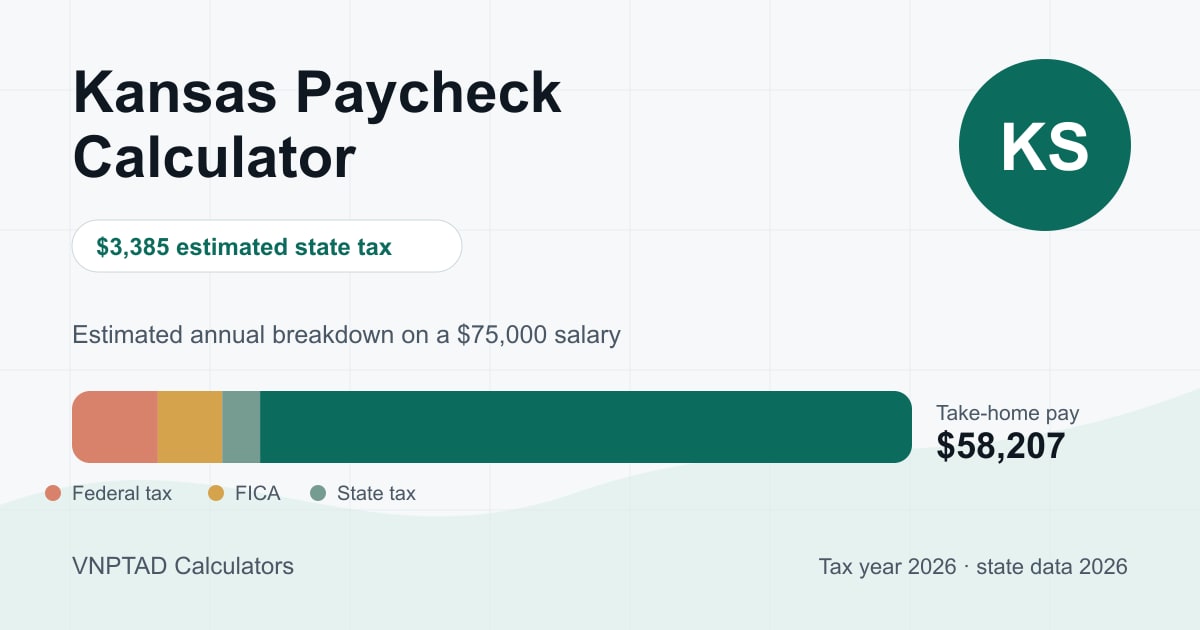
Take-home pay per bi-weekly paycheck
$2,238.74
Annual take-home
$58,207.19
Effective tax rate 22.39%
State rates for Kansas have not been verified against the state revenue department for the current tax year. Treat the state line as an estimate.
| Item | Per paycheck | Per year |
|---|---|---|
| Gross pay | $2,884.62 | $75,000.00 |
| Federal income tax | -$295.00 | -$7,670.00 |
| Social Security | -$178.85 | -$4,650.00 |
| Medicare | -$41.83 | -$1,087.50 |
| Kansas income tax | -$130.20 | -$3,385.31 |
| Take-home pay | $2,238.74 | $58,207.19 |
State tax figures sourced from the Kansas revenue department for tax year 2026. Federal figures from the IRS for tax year 2026.
Taxes on a Kansas paycheck
Kansas taxes income at 5.20% and 5.58% in two brackets, replacing a three-bracket schedule under a 2024 special-session overhaul. It grants both a standard deduction and a separate $9,160 personal exemption per filer ($2,320 more per dependent), which this calculator folds into a single combined allowance and does not otherwise itemise.
Take-home pay at common Kansas salaries
Single filer, paid every two weeks, standard deduction, no retirement or benefit deductions. Your own figure will differ once those are included — use the calculator above for that.
| Gross salary | Per paycheck | Annual take-home | Effective rate |
|---|---|---|---|
| $50,000 | $1,552.49 | $40,364.69 | 19.3% |
| $75,000 | $2,238.74 | $58,207.19 | 22.4% |
| $100,000 | $2,861.53 | $74,399.69 | 25.6% |
| $150,000 | $4,085.41 | $106,220.69 | 29.2% |
How Kansas withholding interacts with federal tax
State and federal tax are calculated separately, on different taxable-income figures. Kansas starts from its own definition of taxable income, applies its own deduction, and uses its own rate schedule. A deduction that lowers your federal bill does not always lower your state bill by the same amount, and in some cases does not lower it at all.
One consequence worth knowing: if you moved into or out of Kansas during the year, you will likely file a part-year resident return, and your withholding through the year may not match what you actually owe. That is normal, and it settles at filing.
Checking this against your pay stub
Take your most recent stub and compare it row by row against the table in the calculator. Federal, Social Security and Medicare should line up closely. If the total is off, the difference usually sits in one of these:
- A W-4 with dependents claimed, extra withholding, or a second job entered in Step 2
- Pre-tax benefit deductions you have not entered above
- A local city or county income tax, which this calculator does not model
- Year-to-date effects, such as Social Security stopping once you pass the wage base
Compare take-home pay with other states
State withholding is only one part of the comparison, but using the same salary and filing status makes the paycheck difference easy to see.
Frequently asked questions
Does Kansas have a state income tax?
Kansas taxes income at 5.20% and 5.58% in two brackets, replacing a three-bracket schedule under a 2024 special-session overhaul. It grants both a standard deduction and a separate $9,160 personal exemption per filer ($2,320 more per dependent), which this calculator folds into a single combined allowance and does not otherwise itemise.
How much is taken out of a paycheck in Kansas?
On a $75,000 salary paid every two weeks, a single filer in Kansas takes home about $2,238.74 per paycheck, or $58,207.19 for the year. That is an effective tax rate of 22.4% once federal income tax, Social Security and Medicare are counted, plus state withholding.
What is the Kansas withholding rate?
Kansas taxes income at 5.20% and 5.58% in two brackets, replacing a three-bracket schedule under a 2024 special-session overhaul. It grants both a standard deduction and a separate $9,160 personal exemption per filer ($2,320 more per dependent), which this calculator folds into a single combined allowance and does not otherwise itemise. The figures used here come from the Kansas revenue department; the source is linked below the calculator so you can confirm the current year's rates.
Is it cheaper to work in Kansas than in a high-tax state?
On income tax alone, it depends on where you are comparing to — states with no income tax keep more of your salary, while several states tax at higher rates than Kansas. But income tax is one line in a budget. Property tax, sales tax and housing costs often move in the opposite direction, and states without an income tax generally raise the difference elsewhere.
Related calculators
- Sales Tax Calculator Add sales tax to a price, or work backwards from a tax-included total to find the price before tax.
- Self-Employment Tax Calculator See your Social Security and Medicare tax on freelance or business income, including the deduction most people miss.
- Bonus Tax Calculator See what a bonus is taxed under the flat 22% method versus what you likely actually owe.